A Crisis Within a Crisis: Understanding the Climate–Conflict Nexus
Cameroon sits at a dangerous intersection. It is a country of extraordinary ecological diversity — from the Sahel borderlands in the Far North to the rainforests of the South — yet this very diversity makes it acutely exposed to the cascading consequences of a warming planet. For humanitarian organisations working on the ground, the relationship between climate change and conflict in Cameroon is not a theoretical concern. It is the lived reality of millions of people.
Since its founding in 1993, SHUMAS (Strategic Humanitarian Services), headquartered in Bamenda, Northwest Region, has documented how environmental degradation quietly dismantles the social contracts that hold communities together. When harvests fail, when rivers run dry, when grazing land turns to dust, the competition for what remains rarely stays peaceful. Across Africa's Sahel belt, the evidence is overwhelming: climate stress is one of the most powerful accelerants of localised conflict, displacement, and food insecurity known today.
Cameroon is not an exception. It is, in many respects, one of the continent's most instructive case studies.
Lake Chad and the Far North: When the Water Disappears
The story of Lake Chad is one of the most cited environmental tragedies of the 20th and 21st centuries — and for good reason. Since the 1960s, the lake has lost approximately 90 per cent of its surface area, shrinking from roughly 25,000 square kilometres to fewer than 2,500. The consequences for Cameroon's Far North Region have been catastrophic.
Fishing communities that sustained their livelihoods for generations have watched their waters recede. Pastoralists and farmers — already competing for scarce fertile land — have been pushed into increasingly violent confrontations. Boko Haram and other armed groups have exploited this vacuum of desperation, recruiting among young men with no economic future, no land, and no viable alternative. The United Nations Environment Programme and the African Union have both formally recognised Lake Chad's contraction as a threat multiplier for instability across the entire basin.
SHUMAS field teams, working in partnership with WFP, UNICEF, and IOM, have witnessed these dynamics directly in the Lake Chad basin communities of the Far North. The humanitarian needs are not simply the result of armed violence — they are rooted in an ecological unravelling that predates the current security crisis by decades. Addressing displacement and food insecurity in this region without addressing the environmental drivers is, quite simply, building on sand.
The Northwest Crisis and Climate Vulnerability: A Compound Emergency
The Northwest and Southwest Regions of Cameroon have been engulfed in an armed crisis since 2017, displacing over 700,000 people internally and forcing hundreds of thousands more across international borders. SHUMAS, based in Bamenda at the heart of this crisis, has operated throughout this period, delivering protection, nutrition, shelter, and livelihoods support to conflict-affected populations across all 31 divisions in which it works.
Yet even within the Anglophone crisis, climate variables are shaping the humanitarian landscape in ways that demand attention. Erratic rainfall, prolonged dry seasons, and soil degradation are reducing agricultural yields precisely when farming is the primary survival strategy for internally displaced persons (IDPs) sheltering in rural host communities. When a displaced family relocates to a host village and that village is itself struggling with a failed harvest, the strain on social cohesion is immense.
SHUMAS, in collaboration with UNFPA and IRC, has observed that climate-driven food insecurity compounds protection risks — particularly for women and girls. When household resources are exhausted, girls are more likely to be withdrawn from school, child marriage rates rise, and women face heightened risks of gender-based violence. The climate change conflict Cameroon nexus, in this sense, is not gender-neutral. It has a distinctly gendered face.
Our partners at UNICEF have similarly documented that malnutrition rates in Northwest Cameroon are driven by a combination of conflict disruption and poor agricultural seasons — a compound emergency that neither a purely humanitarian nor a purely environmental response can adequately address alone.
Displacement, Migration, and the Climate Footprint
One of the most pressing consequences of the intersection of climate change and conflict in Cameroon is the acceleration of internal and cross-border displacement. The Internal Displacement Monitoring Centre estimates that Cameroon hosts over one million internally displaced persons — among the highest figures on the African continent. While the Anglophone crisis accounts for a significant proportion, climate-driven displacement from the Far North and Adamawa Regions contributes substantially to this figure.
Climate migration in Cameroon often does not look like the dramatic exodus depicted in international media. It is quiet, incremental, and desperate. A pastoralist family moves south in search of pasture, encounters farming communities already under pressure, and a dispute over land erupts into violence. A fishing village relocates further inland, settles on land claimed by another ethnic group, and a localised conflict begins. These are not hypothetical scenarios — they are documented patterns that SHUMAS field coordinators encounter in their daily work.
IOM's displacement tracking matrices, which SHUMAS contributes data to, have captured these movements with growing precision. The findings consistently reinforce what communities themselves have long understood: climate change in Cameroon is not a future threat. It is a present driver of suffering, movement, and conflict — one that requires integrated responses that bridge the humanitarian–development–peace nexus.
SHUMAS's Integrated Approach: From Emergency to Resilience
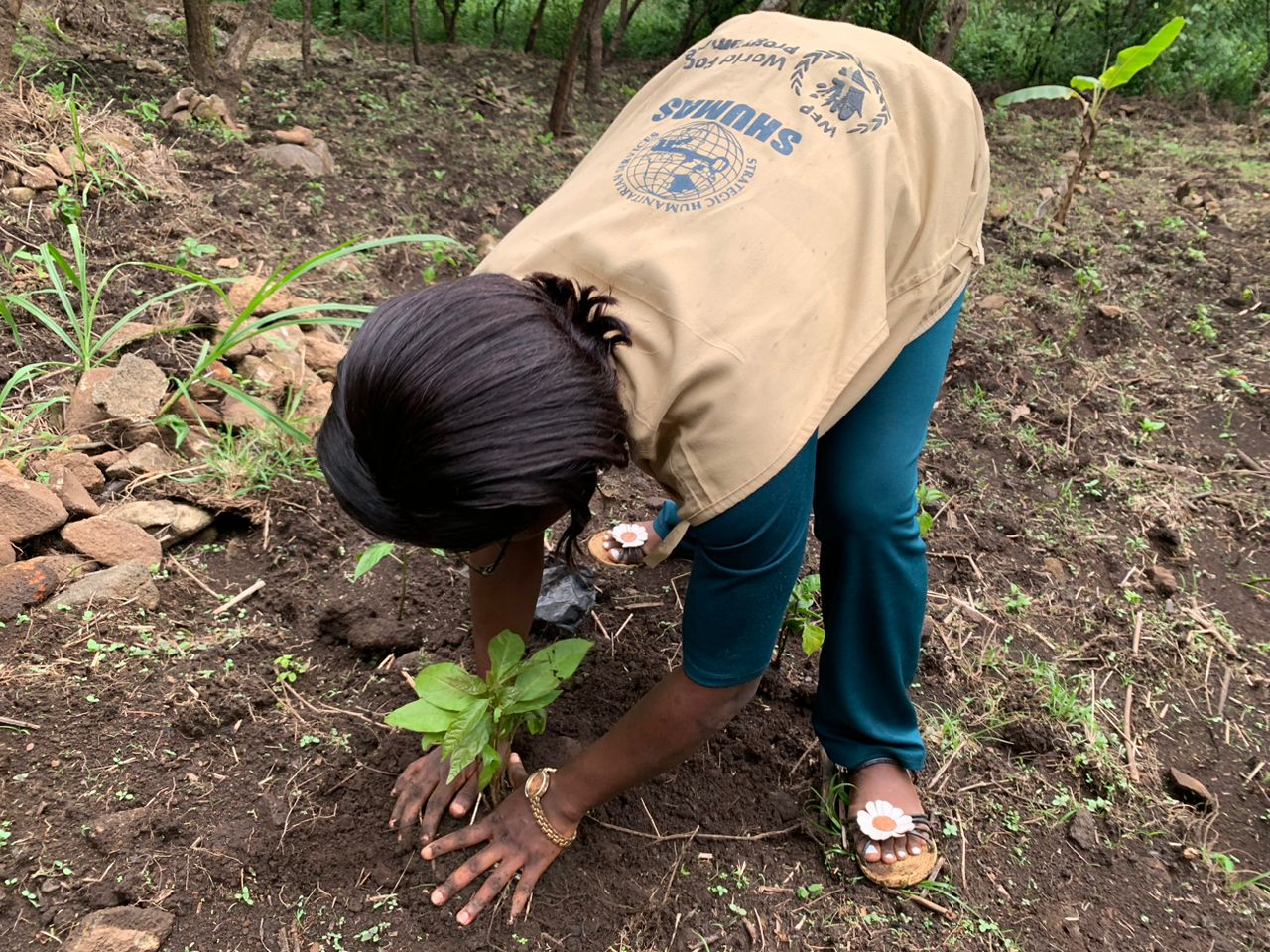
Since 1993, SHUMAS has operated on a fundamental conviction: that emergency response and long-term development cannot be treated as sequential activities. They must be pursued simultaneously. This philosophy has never been more relevant than in the current era of compound crises.
Holding consultative status with the United Nations Economic and Social Council (ECOSOC), SHUMAS is positioned not only as an implementing partner on the ground but as a credible voice in global policy discussions about how the humanitarian system must evolve to meet the realities of climate-driven conflict. Our partnerships with WFP, UNICEF, IRC, UNFPA, and IOM are not merely operational — they are platforms for shared learning, evidence generation, and advocacy.
In practical terms, SHUMAS's integrated programmes in conflict-affected areas of Northwest Cameroon include:
- Climate-smart agriculture and livelihoods — equipping IDPs and host communities with drought-resistant seeds, water-harvesting techniques, and market linkages to restore self-reliance in degraded environments.
- Protection and psychosocial support — addressing the trauma that compound emergencies produce, with particular focus on women, children, and persons with disabilities.
- Community peacebuilding — facilitating dialogue between farmer and herder communities whose conflicts are frequently rooted in competition over climate-stressed resources.
- Data and evidence generation — contributing field-level data to UN tracking systems to ensure that climate and conflict variables are captured together, not in isolation.
This integrated model reflects a broader truth that the international humanitarian system is only beginning to fully embrace: you cannot build lasting peace on a foundation of ecological collapse, and you cannot achieve climate resilience in communities torn apart by violence. The two agendas must advance together.
What Must Happen Next: Policy, Funding, and Partnerships

The connection between climate change, conflict, and humanitarian need in Cameroon demands an urgent response — not only from NGOs and UN agencies, but from donor governments, the African Union, and the Cameroonian government itself.
First, climate finance must flow to conflict-affected fragile states. Currently, the communities most exposed to climate risk are systematically excluded from adaptation funding because their instability makes them unattractive to risk-averse donors. This must change. The Green Climate Fund, the Adaptation Fund, and bilateral climate finance mechanisms must develop conflict-sensitive programming windows that reach the people who need them most.
Second, humanitarian response plans for Cameroon — including the Cameroon Humanitarian Response Plan coordinated by OCHA — must explicitly integrate climate risk analysis. Needs assessments that treat climate and conflict as separate variables will consistently underestimate the scale of vulnerability and misallocate resources.
Third, local organisations like SHUMAS, with deep community trust, multi-decade field presence, and established UN partnerships, must be adequately resourced to lead. The localisation agenda endorsed at the World Humanitarian Summit in 2016 remains largely unrealised. Changing this is not a matter of principle alone — it is a matter of effectiveness. Local organisations reach people that international systems cannot, and they do so at a fraction of the cost.
The road from Lake Chad's shrinking shores to Bamenda's displacement camps is long, but it is a single road. Climate change and conflict in Cameroon are not parallel crises — they are one crisis, with one set of root causes and one imperative for response.
SHUMAS has walked that road for over three decades. We understand its terrain. And we are committed to walking it with the communities we serve until they can walk it themselves — in safety, dignity, and resilience.
Partner with SHUMAS. Fund the evidence. Build the resilience. If you believe that lasting peace requires tackling both conflict and climate, we invite you to join us. Visit shumas.org to make a donation, explore partnership opportunities, or learn more about our work across Cameroon's most vulnerable communities. Together, we can close the gap between the crisis of today and the stability of tomorrow.